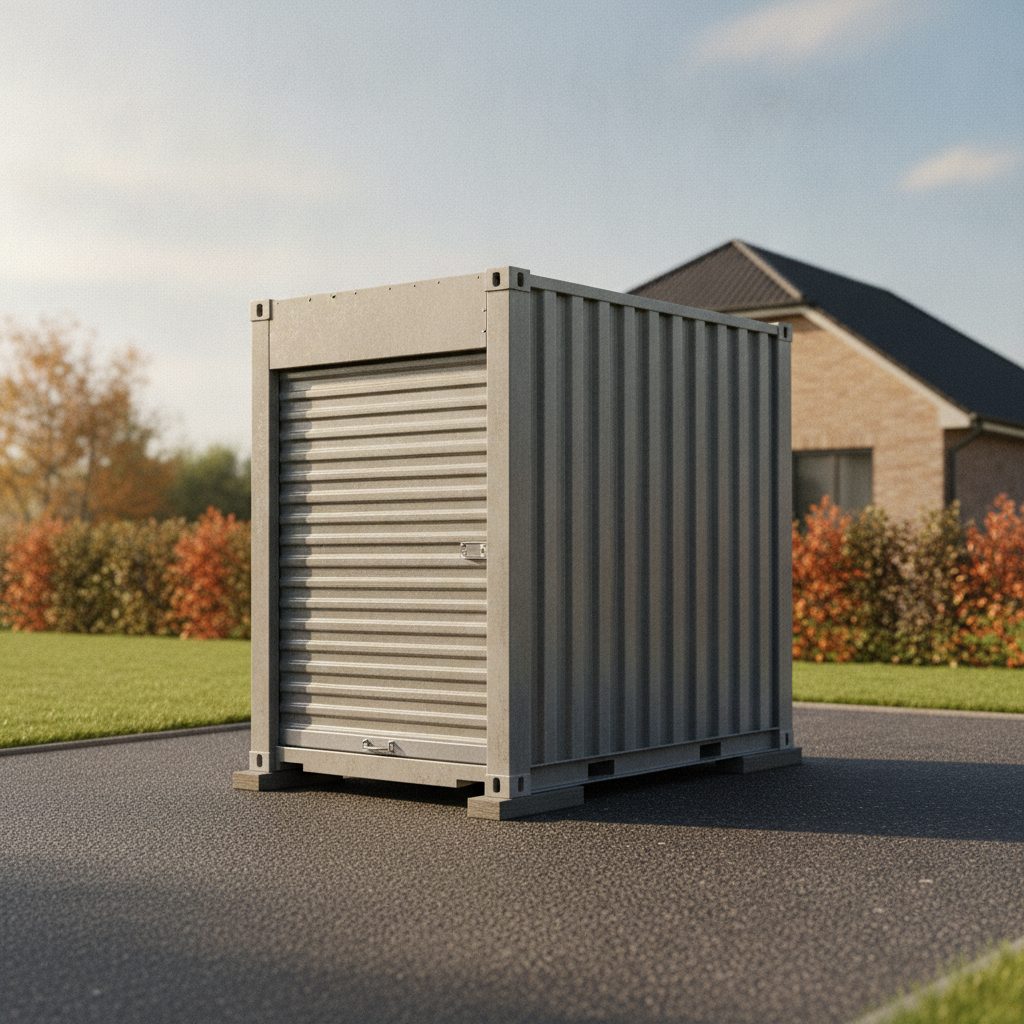
A moving and storage container typically costs $300 to $700 for a local move under 50 miles, $1,500 to $5,000 for a long-distance move across states, and $3,000 to $8,000 for a cross-country move with a large home, plus $150 to $300 per month if you need storage. Run the cost calculator above with your own ZIP code, home size, and move distance for a more exact range. Every figure comes from the pricing table further down this page.
About moving container costs
The ranges below are drawn from published US provider pricing and consumer-reported quotes. Your number shifts based on ZIP code, season, and which company you use. PODS, for example, prices zone-to-zone rather than by mile, so two similar routes can quote differently. Run the calculator, then get a written quote before you commit to anything.
Average moving container cost
| Move type | What you'll likely pay |
| Local move (1 container) | $300 - $700 |
| Regional (about 250 mi) | $800 - $1,800 |
| Long-distance | $1,500 - $5,000 |
| Cross-country (large home) | $3,000 - $8,000 |
| Monthly storage | $150 - $300 |
Worked example
Take a studio apartment moving locally, under 50 miles, with no storage needed. That falls at the low end of the local move range above: $300 to $700. Now add one month of storage after the move while the new place gets ready: $150 to $300 more. The total for that move comes to $450 on the low end and $1,000 on the high end, using only the ranges from the table above.
What affects moving container cost
- Distance. Transport cost scales with miles. A cross-country 16-foot container can run four times what a local one does.
- Number of containers. Each extra container adds its own delivery and transport fee, not just a storage charge.
- Storage time. The first month is usually in the base quote. After that, $95 to $250 per month, per container.
- Season. Summer and month-end moves carry a 10 to 20 percent premium. Avoid June through August if you can.
- Access and permits. A city street permit can add $50 to $150. Rural addresses sometimes add a delivery surcharge too.
- Provider. Quotes for the same route can differ by $400 between PODS, U-Pack, and 1-800-PACK-RAT. Get at least two.
Which page to read for your situation
The calculator above gives you a range in seconds. If you want the reasoning behind a specific number, one of these guides probably matches your move better than the general FAQ does.
- Not sure what size to book? Start with cost by container size. It breaks down the 7-foot, 12-foot, and 16-foot options against room counts, not just cubic feet.
- Moving more than 500 miles? The long-distance guide has corridor-level examples (New York to Florida, Chicago to Texas, and others) instead of a single national average.
- Weighing a container against a rental truck? Pod vs truck rental adds in the fuel, hotels, and tolls that a bare rental-truck quote leaves out.
- Planning to leave the container in storage a while? Monthly storage cost covers on-site versus facility storage and what happens after the first free month.
- Choosing between providers? Companies compared lines up PODS, U-Box, 1-800-PACK-RAT, and Moving Place on coverage and price position.
A worked example using the calculator's own numbers
The calculator prices a container move from a base range of $500 to $900, then multiplies by the factors you select. Here is what that looks like for a real household: a 2 to 3 bedroom home (multiplier 1.8) moving long-distance (multiplier 4), with no extra storage (multiplier 1), and no ZIP code entered.
$500 × 4 × 1.8 = $3,600 on the low end. $900 × 4 × 1.8 = $6,480 on the high end. Rounded to the nearest $10, the calculator shows $3,600 to $6,480.
Add a ZIP code and the number moves again. A ZIP in the 902 prefix (Los Angeles area) carries a 1.22 multiplier for being a high-cost market. The same household moving from or to that ZIP would see roughly $610 to $1,100 on a local move instead of the unadjusted $500 to $900, because $500 × 1.22 rounds to $610 and $900 × 1.22 rounds to $1,100. That is the ZIP adjustment doing its job: it is not a flat surcharge, it is a market multiplier applied to whatever your distance and size already produced.
What the estimate assumes
The calculator multiplies four inputs together: a distance factor, a home-size factor, a storage factor, and a ZIP-based market factor. It does not know your specific provider, your exact route, or whether a fuel surcharge applies at the time you book. The output is a planning range, not a quote. Ranges are built from published US provider pricing and consumer-reported figures, and they get updated as pricing data changes. Treat the number as a starting point for comparing written quotes, not as a ceiling on what a provider can charge.
Before you decide: common questions
How much does a moving container cost?
Local moves run $300 to $700. Long-distance container moves typically run $1,500 to $5,000, with coast-to-coast large homes reaching $8,000.
Are moving containers cheaper than movers?
Usually, yes. A full-service mover for a two-bedroom interstate move can run $3,000 to $7,000. A container for the same household is typically $1,500 to $3,500 because you do your own loading. They cost more than a truck rental, but you do not have to drive the truck.
How many containers do I need?
Roughly one container per one to two rooms. A studio fits in a 7-foot unit, a two to three bedroom home in a 12-foot, and a large house in a 16-foot. When you are on the border, go one size up rather than renting two containers. Two containers means two delivery fees.
How long can I keep a moving container?
Most providers rent month to month. The first month is usually included in the base quote. After that, you pay the monthly storage rate until you schedule delivery or return the container. Some providers have a two-month minimum on long-distance moves; confirm before signing.
Do I load the container myself?
Yes. You pack and load; the provider handles transport. If you want help, local moving labor companies book separately for $200 to $600 on each end. You still come in well below a full-service mover even after paying for labor.
How much do PODS typically cost for moving?
A local PODS move generally costs $300 to $700. A long-distance move across several states runs $1,000 to $3,000 or more, depending on distance and container size. The quote covers delivery, a loading period, pickup, and storage or transport to the destination. Rates vary by season and location, and the online quote tool is reasonably accurate if you use your actual ZIP codes.
Are moving pods cheaper than movers?
For long-distance moves, pods are almost always cheaper because you do the loading and unloading. For local moves the gap is smaller: a full-service local crew can be surprisingly efficient. The trade is time versus money. Pods save money; full-service movers save your back.
What are the disadvantages of PODS?
You do all the loading and unloading yourself. Delivery windows for long-distance moves are typically one to three weeks, not a guaranteed date, so you need flexibility on both ends. Container availability can be tight in smaller markets. Storage fees accumulate quickly on a delayed move: one extra month on a 16-foot container adds $185 to $260 to your bill.
Which is cheaper, PODS or U-Box?
U-Box is often cheaper for small loads because U-Haul's freight network keeps long-haul costs down. The catch: U-Box containers are only about 8 feet, so a large household may need two, which closes the gap fast. PODS offers a 16-foot container that handles most three to four bedroom homes in a single unit. Get quotes from both for your specific route before you decide.
In-depth moving container guides
Get quotes to check the estimate against
Container quotes vary by provider, route, and the week you ask. Prices are not fixed. Getting two or three quotes for your specific dates is the most direct way to find a lower number.
Ready to compare real numbers?
Submit your route once and providers respond with their own pricing, not ours.Compare quotes
A portion of completed quote requests supports this calculator; your rate is unaffected either way.